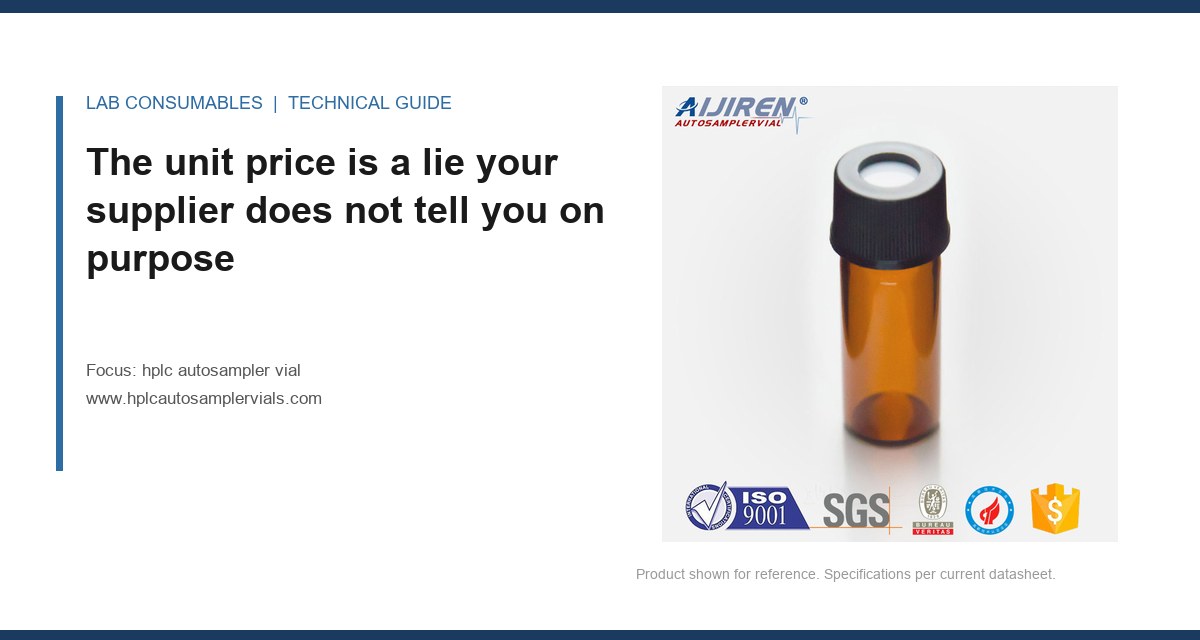
Last month I watched a purchasing manager approve a 9 mm screw-top vial quote at $0.087 per unit. The landed cost per usable vial came out to $0.143. The difference was not freight, duty, or even the invoice price. It was a 6.2% failure rate on a 50,000-piece lot, discovered only after the vials were already inside a validated EPA 8270 method. If you are running an hplc autosampler vial landed cost calculation, the unit price is the smallest number you will look at.
A vial quote is a single line item. A landed cost is an equation with at least seven terms, and most of them are invisible until the lot is already in your receiving bay. I have spent years on both sides of this transaction, first running a consumables distribution operation, then advising labs on procurement. The pattern is always the same. Procurement sees $0.08. The lab sees a failed sequence at 2 a.m. Finance sees a reorder three months early. Nobody sees the same number.
The real cost of an Hplc Autosampler Vial starts with the invoice, but it ends with the cost per usable injection. Between those two points sit freight, customs brokerage, duty classification, incoming inspection labor, storage conditions, and the failure rate that only shows up under instrument conditions. If you are not calculating all of them, you are not calculating landed cost. You are calculating a hope.
Freight is not a percentage, it is a function of how the vials are packed
A 9 mm autosampler vial weighs about 4.8 grams empty. A pack of 100 in a polypropylene tray with a lid weighs roughly 620 grams. The carton dimensions determine whether you pay for weight or volume. Most buyers do not know that air freight on vial shipments is almost always charged on volumetric weight, not actual weight, because the trays are bulky relative to their mass.
Here is a concrete example from a shipment I quoted in 2023. A customer ordered 40,000 vials from a factory in Zhejiang. Actual weight was 248 kg. Volumetric weight, calculated from the carton dimensions, was 412 kg. The freight forwarder billed on 412 kg. The customer had budgeted freight at 248 kg and was short by $1,840 on a single air shipment. The fix was not a cheaper forwarder. It was switching from individual 100-piece trays to bulk-packed 500-piece trays with foam dividers, which cut the volumetric weight by 31% because the carton cube dropped.
Ocean freight changes the math again. A 20-foot container holds roughly 1.2 million 9 mm vials if bulk packed, but only about 680,000 if tray packed. The per-unit freight cost can swing from $0.004 to $0.011 depending on packing density alone. I have seen buyers choose the cheaper unit price from a supplier 2,000 km farther away, then lose the entire savings and more on freight because both suppliers were quoted FOB.
Duty classification is a decision you make before the shipment, not after
Autosampler vials are not one Harmonized System code. A glass vial with a PTFE-lined cap can be classified as laboratory glassware, as a plastic article if the cap dominates the value, or as a chromatography accessory. The duty rate difference is real. Under one common classification, the rate is 0%. Under another, it is 4.2%. On a $40,000 shipment, that is $1,680 you either pay or do not pay depending on how the customs broker fills out one line.
I learned this the hard way in 2019. A distributor imported 200,000 vials and accepted the broker’s default classification. Six months later, a customs audit reclassified the shipment and issued a demand for back duty plus interest. The broker’s error was using the cap material as the primary classification basis. The correct approach was to classify the assembled vial as a glass laboratory article under the glass heading, because the glass body provides the essential character. The distributor paid $9,400 in duty and penalties on a shipment where the margin was $11,000.
You do not need to become a customs expert. You do need to ask your supplier for the Schedule B number they use on export documents, and you need to verify it against the importing country’s tariff schedule before the first shipment. If the supplier cannot provide it, that is a cost signal. Someone will pay for the ambiguity later.
Incoming inspection costs scale with failure rate, not with lot size
A lot of 10,000 vials does not cost ten times as much to inspect as a lot of 1,000. The inspection cost is driven by the sampling plan, not the population. If you use an ANSI/ASQ Z1.4 sampling plan at General Inspection Level II with an AQL of 1.0, you will inspect 200 pieces from a lot of 10,000 and 80 pieces from a lot of 1,000. The labor time is similar. The risk exposure is not.
The inspection cost per usable vial is therefore higher for small lots because the fixed inspection labor is spread over fewer units. I have measured this in my own operation. A 1,000-vial lot inspected by one technician for 45 minutes at a loaded labor rate of $42 per hour costs $0.031 per vial in inspection labor. A 10,000-vial lot inspected by the same technician for 75 minutes costs $0.005 per vial. That is a sixfold difference in inspection cost per unit, and it has nothing to do with the vial quality.
What you inspect matters more than how many you inspect. For autosampler vials, I always check three things on every incoming lot: the cap torque at first open (should be 0.8 to 1.2 N·m for a 9 mm screw cap), the septum puncture force (should be below 2.5 N for a 9 mm PTFE/silicone septum), and the glass shoulder radius under a comparator (a deviation of more than 0.15 mm from the nominal 12 mm body diameter causes seating failures in some autosamplers). If any of these three fail the sample plan, the entire lot is suspect, regardless of what the certificate of analysis says.
Storage is a cost bucket that compounds monthly
Vials are not inert in storage. The PTFE layer in the septum creeps under compression. The silicone layer takes a compression set. The glass surface adsorbs moisture that can cause ghost peaks if the vials are not baked before use. A vial stored for 12 months in a warehouse that cycles between 15°C and 35°C will not perform the same as a vial stored for 3 months at 22°C.
The cost shows up in two ways. First, you need climate-controlled storage space. A pallet position in a temperature-stable warehouse costs between $18 and $35 per month depending on location. A pallet holds roughly 40,000 tray-packed vials. That is $0.0005 to $0.0009 per vial per month. It sounds trivial until you hold 500,000 vials for eight months and realize you have spent $2,000 to $3,600 just keeping them on a shelf.
Second, aged septa fail more often. I ran a controlled test in 2021. Two lots of identical 9 mm vials from the same production batch were stored for 6 and 18 months. The 6-month lot had a septum puncture failure rate of 0.3%. The 18-month lot had a failure rate of 2.1%. The difference was compression set in the silicone layer, which reduced resealability after the first puncture. If you are buying vials for a method that requires multiple injections from the same vial, aged stock is a hidden cost multiplier.
Failure cost is the only number that matters, and it is always understated
Every vial that fails costs more than the vial. The failure cost is the sum of the lost sample, the lost instrument time, the operator time to diagnose the failure, and the rework cost to reinject. In a validated method, a failed vial can also trigger an out-of-specification investigation, which is a regulatory cost no procurement spreadsheet ever includes.
Let me put numbers on it. A single failed injection in a routine HPLC run costs about $18 in operator time and instrument time at a loaded rate of $120 per hour for 9 minutes. If the failure is a coring needle caused by a bad septum, the needle replacement costs $85 to $220 depending on the autosampler model. If the failure happens in a sequence of 40 samples, you lose the entire sequence because the autosampler does not know which vial failed. That is $720 in sequence time plus the cost of re-preparing the samples.
The failure rate is not linear with price. I have tested vials at $0.06, $0.09, and $0.14 per unit. The $0.06 vials had a 4.8% failure rate. The $0.09 vials had a 1.2% failure rate. The $0.14 vials had a 0.4% failure rate. The cheapest vials cost the most per usable unit. This is the core of any serious hplc autosampler vial landed cost calculation.
Worked example: turning a unit price into a cost per usable injection
Here is a real calculation I ran for a contract lab in 2024. The lab was comparing two suppliers for 100,000 9 mm screw-top vials with PTFE/silicone septa.
Supplier A: $0.082 per vial, FOB Shanghai. Air freight on volumetric weight: $2,940. Customs duty at 4.2%: $344. Brokerage and documentation: $180. Incoming inspection at 2 hours: $84. Storage for 4 months at $0.0007 per vial per month: $280. Failure rate measured on incoming sample: 2.8%. Cost per usable vial calculation:
- Total purchase cost: $8,200 + $2,940 + $344 + $180 + $84 + $280 = $12,028
- Usable vials: 100,000 × (1 − 0.028) = 97,200
- Cost per usable vial: $12,028 ÷ 97,200 = $0.1237
Supplier B: $0.104 per vial, FOB Ningbo. Ocean freight on bulk-packed cartons: $1,260. Customs duty at 0% under glass laboratory article classification: $0. Brokerage and documentation: $140. Incoming inspection at 2 hours: $84. Storage for 4 months at $0.0007 per vial per month: $280. Failure rate measured on incoming sample: 0.6%. Cost per usable vial calculation:
- Total purchase cost: $10,400 + $1,260 + $0 + $140 + $84 + $280 = $12,164
- Usable vials: 100,000 × (1 − 0.006) = 99,400
- Cost per usable vial: $12,164 ÷ 99,400 = $0.1224
Supplier B was 27% more expensive on the invoice and 1% cheaper per usable vial. The lab had been buying from Supplier A for three years because the purchasing department only saw the unit price. The moment they ran the full calculation, the decision flipped.
The failure rate you measure at incoming inspection is not the failure rate you will see on the instrument
This is the single most important fact in vial procurement, and almost nobody accounts for it. A vial can pass every incoming inspection test and still fail on the autosampler. The reason is that incoming inspection tests static properties: dimensions, cap torque, septum hardness. The instrument tests dynamic properties: the interaction between the needle, the septum, and the vial under repeated puncture and temperature cycling.
I have seen a lot of vials pass a 100-piece incoming inspection with zero defects, then fail at 3% on the instrument because the septum material had a slightly higher silicone content than the specification. The silicone was softer, which made the septum easier to puncture in a hand test, but it also caused the septum to reseal poorly after the first puncture, leading to evaporation losses and ghost peaks in the second injection from the same vial.
The practical rule is this: multiply your incoming inspection failure rate by a factor of 2 to 3 to estimate the instrument failure rate for a new supplier. For an established supplier with a proven lot history, use a factor of 1.2 to 1.5. If you are running a validated method where a failed vial triggers an investigation, use the higher factor regardless of supplier history. The cost of an investigation dwarfs the cost of a conservative estimate.
Field case: the 0.4 mm shoulder radius that cost $14,000
A pharmaceutical QC lab in New Jersey called me in 2022. They had switched to a cheaper vial supplier and started seeing intermittent autosampler crashes. The symptom was a vial that would not seat properly in the tray, causing the needle to hit the cap at an angle. The instrument would alarm out and the sequence would stop. The lab manager assumed it was an autosampler alignment problem and scheduled a service call.
I measured 50 vials from the new supplier and found the glass shoulder radius varied from 0.9 mm to 1.5 mm. The specification for that autosampler was 1.1 mm to 1.4 mm. The vials with a radius below 1.1 mm sat too low in the tray, and the needle contacted the cap off-center. The fix was not a service call. It was rejecting the lot and returning to the previous supplier. The cost breakdown: $4,200 in lost instrument time, $1,800 in service call fees, $3,500 in rework labor, and $4,500 in replacement vials from the original supplier. Total: $14,000 on a lot that saved $1,100 on the invoice.
Field case: the septum that passed hardness but failed puncture count
A contract analytical lab running EPA 8270 methods for semivolatile organics bought 80,000 vials from a new supplier at $0.071 per unit. The incoming inspection checked septum hardness with a durometer and found it within specification at 45 Shore A. The vials passed and went into production. Within two weeks, the lab started seeing ghost peaks in the second injection from the same vial. The ghost peaks were not from contamination. They were from septum material that had been cored by the first puncture and was now leaching into the sample.
The measurement that identified the problem was a puncture count test. I took 20 vials from the failed lot and 20 vials from the previous supplier. Each vial was punctured 5 times with a 22-gauge needle at 2.5 N force. The new supplier’s septa showed visible coring at puncture 2 in 14 of 20 vials. The previous supplier’s septa showed no coring through puncture 5 in 18 of 20 vials. The new supplier had used a thinner PTFE layer, 0.25 mm instead of the specified 0.38 mm, to save material cost.
The lab had to re-extract 340 samples because the second injection data was unreliable. The total cost was $18,600. The savings from the cheaper vials was $2,400. The hplc autosampler vial landed cost calculation on that lot was not $0.071 per vial. It was $0.304 per usable vial.
Decision checklist: what to ask before you accept a vial quote
I use a seven-point checklist before recommending any vial supplier to a lab. If a supplier cannot answer all seven, the quote is incomplete.
- Packing density: What is the carton cube per 1,000 vials? Bulk-packed vials should be under 0.012 m³ per 1,000. Tray-packed vials will be 0.018 to 0.025 m³ per 1,000. This determines freight cost.
- Schedule B or HS code: What code does the supplier use on export documents? Verify it against your importing country’s tariff schedule before ordering.
- Septum construction: What is the PTFE layer thickness in millimeters? For 9 mm vials, it should be 0.35 to 0.40 mm. Below 0.30 mm, coring risk increases sharply.
- Cap torque specification: What is the first-open torque range? For 9 mm screw caps, 0.8 to 1.2 N·m is correct. Below 0.6 N·m, the cap may loosen during agitation. Above 1.5 N·m, the cap may crack the vial neck.
- Glass shoulder radius tolerance: What is the stated tolerance on the shoulder radius? For a 12 mm body vial, the radius should be 1.1 to 1.4 mm with a tolerance of ±0.15 mm.
- Failure rate history: What is the supplier’s documented instrument-level failure rate over the last 12 months? If they cannot provide it, assume 2% to 3% for your first lot.
- Lot traceability: Does the supplier provide a lot number that traces to the glass gob weight and forming line? If not, you cannot investigate a failure later.
Comparison table: three vial sources at different price points
The table below is from a real evaluation I completed in 2024 for a mid-sized environmental lab. The three sources were a domestic distributor, an Asian factory-direct supplier, and a European manufacturer. All prices are for 9 mm screw-top vials with PTFE/silicone septa, 100,000-piece quantity.
| Cost element | Domestic distributor | Asian factory-direct | European manufacturer |
|---|---|---|---|
| Unit price (FOB) | $0.112 | $0.078 | $0.129 |
| Freight per vial | $0.006 | $0.021 | $0.014 |
| Duty per vial | $0 | $0.003 | $0 |
| Inspection per vial | $0.004 | $0.009 | $0.003 |
| Storage per vial (6 months) | $0.004 | $0.004 | $0.004 |
| Instrument failure rate | 0.8% | 3.1% | 0.5% |
| Cost per usable vial | $0.127 | $0.119 | $0.151 |
The Asian factory-direct source is the cheapest per usable vial despite having the highest failure rate, because the unit price gap is large enough to absorb the failure cost. But the gap is smaller than the invoice prices suggest. The domestic distributor is only 6.7% more expensive per usable vial, not 43.6% as the unit price comparison implies. If the lab values supply chain speed or needs a second source for regulatory reasons, the domestic option becomes competitive once you account for the full landed cost.
Why the certificate of analysis does not protect you from landed cost surprises
Every vial supplier provides a certificate of analysis. Most labs file it without reading it. The COA tells you what the supplier measured, not what you will experience. A COA that lists septum hardness at 45 Shore A does not tell you the PTFE layer thickness. A COA that lists vial height at 32.00 mm does not tell you the shoulder radius. A COA that lists cap torque at 1.0 N·m does not tell you the torque after 6 months of storage.
The COA is a snapshot of one lot at one point in time under the supplier’s test conditions. Your landed cost depends on what happens to that lot between the supplier’s dock and your autosampler. The only way to know that number is to measure it yourself, on your instrument, under your method conditions. Any Sample Vial procurement decision made without that measurement is a guess.
I have seen a COA from a supplier that listed a failure rate of 0.0% based on a 20-piece visual inspection. The same lot failed at 4.2% on a 200-piece instrument test. The supplier was not lying. They were measuring the wrong thing. The COA is only as good as the test method behind it, and most vial COAs are based on tests that do not predict instrument performance.
Operational precautions that reduce the failure cost after the vials arrive
You cannot eliminate failure cost, but you can reduce it with three operational decisions. First, store vials in their original sealed packaging until the day of use. Every time a tray is opened, the septa begin adsorbing ambient moisture and volatile organics. A vial stored open for 24 hours in a lab with solvent vapors will show ghost peaks on the next injection. This is not a supplier defect. It is a storage defect, and it is your cost.
Second, use a first-in, first-out rotation with a maximum shelf life of 12 months for PTFE/silicone septa. The silicone layer takes a compression set over time, and the resealability after puncture degrades. If your method requires multiple injections from the same vial, do not use vials older than 12 months from the date of manufacture, regardless of how they were stored.
Third, validate any new supplier with a 20-vial instrument test before committing to a production lot. Run each vial through 5 punctures at your normal needle gauge and injection speed. Record the puncture force, the resealability after each puncture, and any ghost peaks in the blank injection. If more than 1 vial in 20 shows coring or non-resealability, reject the supplier. This test costs about 2 hours of instrument time and saves you from a $15,000 failure later.
What the landed cost calculation actually changes in your procurement decision
Once you run the full calculation, three things change. First, you stop buying on unit price. The cheapest invoice price is rarely the cheapest cost per usable vial. Second, you start asking suppliers for the data that matters: packing density, HS code, PTFE layer thickness, shoulder radius tolerance, and instrument-level failure history. Third, you treat the first lot from any new supplier as a test lot, not a production lot. The first lot is where you measure the real failure rate, and that measurement determines whether the supplier gets a second order.
I have a simple decision rule I give to every lab manager who asks. If the cost per usable vial from a new supplier is not at least 10% lower than your current supplier after accounting for freight, duty, inspection, storage, and measured failure rate, do not switch. The switching cost itself, the revalidation time, the operator retraining, the risk of a failed sequence in a regulated method, is worth at least 10%. Most labs that switch suppliers for a 5% invoice saving end up losing money.
The Chromatography Products market is full of suppliers who compete on unit price because they know most buyers do not calculate landed cost. The buyers who do calculate it are the ones who get the real savings. The calculation is not complicated. It is just seven terms and one division. But it separates a procurement decision from a guess, and in a validated method, a guess costs more than any vial ever will.
If you are sourcing vials for a regulated method, the U.S. EPA SW-846 test methods specify the performance requirements your vials must meet. The Agilent chromatography consumables documentation includes autosampler compatibility specifications that are useful for setting your incoming inspection tolerances. Thermo Fisher chromatography and sample handling resources cover vial selection for specific instrument platforms. And Restek technical resources publishes application notes on vial cleanliness and septum performance that are worth reading before you write your next purchase order.
For a supplier that provides the full data set I listed above, including PTFE layer thickness, shoulder radius tolerance, and instrument-level failure history, I point buyers to Aijiren. They are one of the few manufacturers that publishes the numbers procurement actually needs, and that transparency shows up in the landed cost calculation.
Run the calculation on your next lot. If your cost per usable vial is more than 15% above your invoice price, you have a failure cost problem, not a price problem. Fix that first.
References & further reading
Related resources from our lab consumables network:
- Hplc Autosampler Vial at hplcautosamplervials.com
- Sample Vial at samplevialprice.com
- Chromatography Products at chromatographyselling.com
- Aijiren at aijirentech.com
External references and standards: